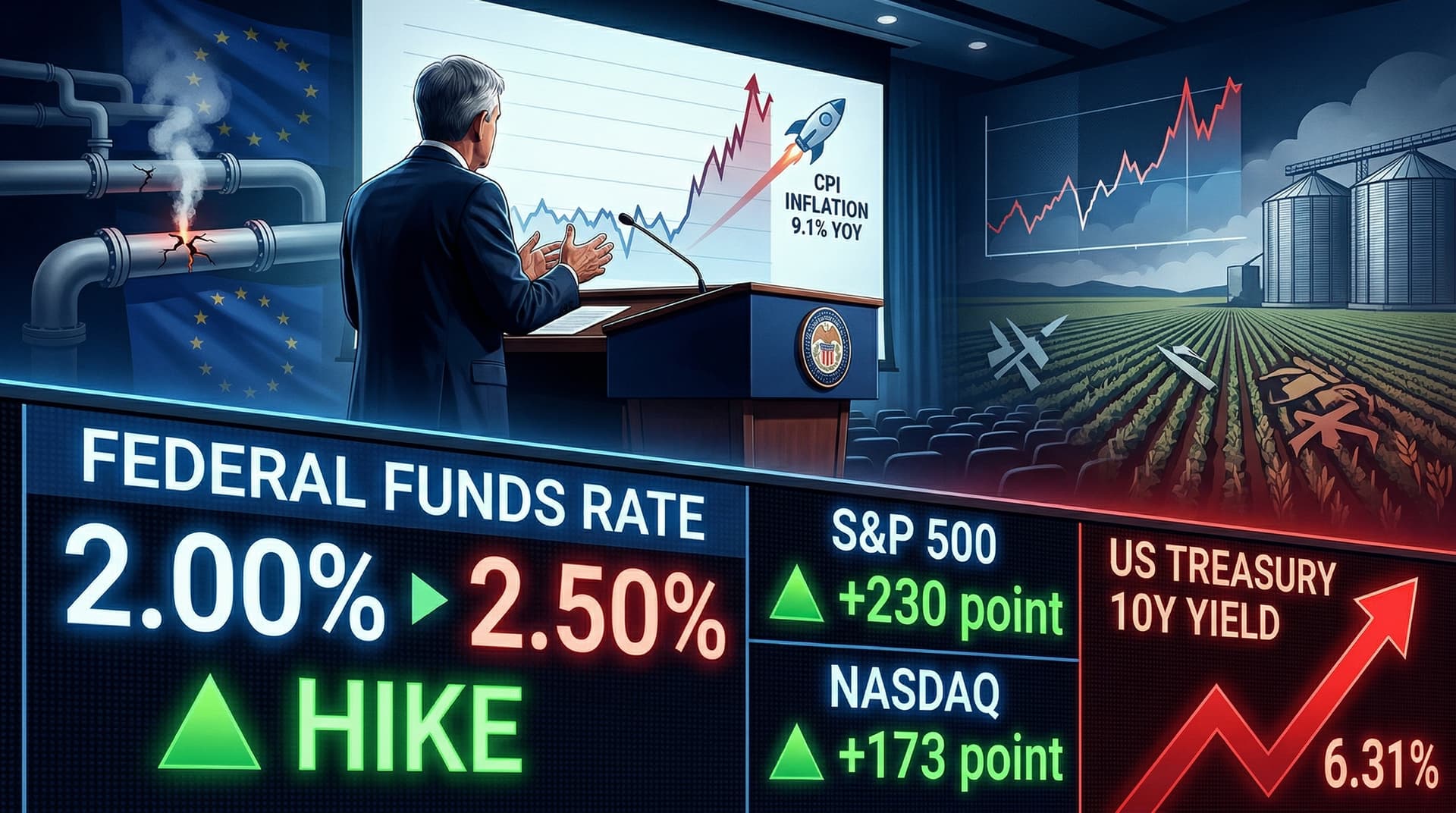
On July 27, 2022, the Federal Reserve executed its most aggressive rate hike in nearly three decades, lifting the federal funds rate by 75 basis points to a range of 2.25% to 2.50%. Chair Jerome Powell described the move as a necessary response to "very strong" inflation data, with the Consumer Price Index (CPI) clocking in at 9.1% year-over-year in June—the hottest reading in 40 years. This decision, telegraphed after the July 13 CPI report stunned markets, underscores the Fed's pivot from pandemic-era stimulus to rapid tightening.
The Inflation Backdrop
Inflation's surge stems from a perfect storm: pandemic-disrupted supply chains, pent-up consumer demand fueled by trillions in fiscal stimulus, and Russia's invasion of Ukraine in February, which spiked energy and food prices. Brent crude hovered around $100 per barrel in July, while European natural gas prices soared amid fears of Russian supply cuts. US gasoline averaged over $4.80 per gallon, eroding household budgets and corporate margins alike.
The July 13 CPI print confirmed core inflation (excluding food and energy) at 5.9%, up from prior months, dashing hopes of a near-term peak. Powell's post-meeting press conference emphasized that the Fed would not waver until price stability—targeted at 2%—was in sight, even if it meant engineering softer labor markets.
Market Reactions: Relief Rally or False Dawn?
Equities initially dipped on hawkish rhetoric but closed higher: the S&P 500 gained 1.2%, Nasdaq rose 2.4%, buoyed by Big Tech resilience. Bond yields climbed, with the 10-year Treasury at 2.72%, reflecting bets on sustained hikes. The US dollar index surged past 106, its highest since 2002, pressuring emerging markets from Turkey to South Africa.
Yet, beneath the surface, cracks appeared. The MOVE index, a gauge of bond market volatility, hit pandemic highs. Inverted yield curves—short-term rates exceeding long-term—flashed recession warnings, a reliable predictor over the past 50 years. Investors piled into safe-havens: gold dipped but Bitcoin rebounded modestly after a brutal first half.
| Key Market Moves Post-Hike | |-----------------------------| | S&P 500 | +1.2% | | Nasdaq | +2.4% | | 10Y Treasury Yield | 2.72% | | DXY (Dollar Index) | +0.8% | | VIX (Fear Gauge) | -5% to 24 |
Global Ripples and Geopolitical Strain
The Fed's actions reverberate worldwide. The ECB, lagging with just 40bps of hikes YTD, faces a dilemma: tighten amid 8.6% eurozone inflation or risk currency collapse. On July 21, it raised rates 50bps for the first time since 2011, but markets price in more to come.
Emerging economies suffer most. India's rupee hit record lows, prompting RBI interventions. Brazil's real weakened despite aggressive hikes. Geopolitics amplifies pain: Europe's energy crunch, with German LNG imports ramping up, could tip the continent into recession, dragging global growth.
Ukraine's war exacts a macro toll. Sanctions on Russian oil capex have tightened supply, propping up prices despite recession fears. China's zero-COVID lockdowns in July slowed its recovery, with factory activity contracting per Caixin PMI, reducing commodity demand.
Recession Risks and Policy Trade-offs
Goldman Sachs upped US recession odds to 30% from 25%; JPMorgan sees 35%. Unemployment at 3.6% masks softening: June payrolls added 372k jobs but downward revisions loomed. Powell acknowledged a potential slowdown but ruled out a Volcker-era shock, citing anchored inflation expectations.
Housing bears the brunt: 30-year mortgage rates near 5.5% have frozen the market, with sales down 18% YoY. Consumer spending, 70% of GDP, shows fatigue—retail sales flat in June.
Critics argue the Fed is behind the curve. Former Treasury Secretary Larry Summers warned of 1970s-style stagflation if hikes lag. Yet, data-dependent Powell signaled 50bps or 75bps in September, with terminal rate eyed at 3.5-3.75%.
Corporate America Adapts
Tech giants hoard cash: Apple, Microsoft sit on $200bn+ combined. Profit warnings mount—FedEx slashed guidance July 21 on weak demand. Energy shines: Exxon up 60% YTD on oil rally. Banks benefit from net interest margins but brace for delinquencies.
M&A slows: Deal volume down 30% YoY amid financing costs. Buybacks persist but at reduced pace.
Outlook: Hawkish Path Ahead
September's Jackson Hole symposium will clarify trajectory. Futures price two more 75bps hikes, then 25bps cuts in 2023. Success hinges on supply shocks abating—Ukraine peace elusive, China reopening uncertain.
For investors, diversify: quality stocks, short-duration bonds, commodities. Geopolitics demands vigilance; a Russian gas halt could force ECB easing, weakening the hawkish consensus.
The Fed's July salvo marks a regime shift. Inflation may bend but not without pain. As Powell said, "We are not going to take a pass." Markets must adapt to higher-for-longer rates in a fractured world.