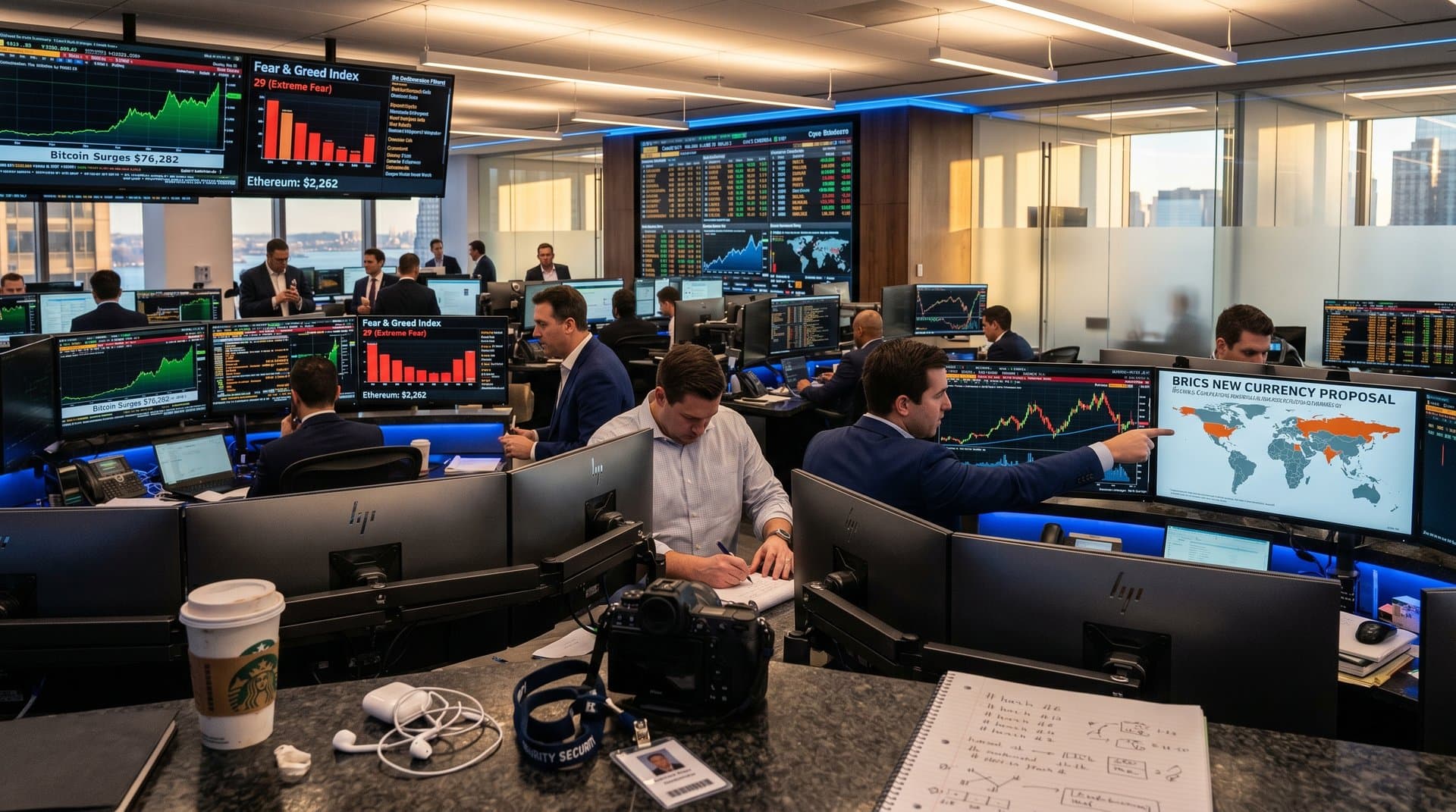
- Fear & Greed Index at 29 historically drives 15% BTC rebounds within 30 days.
- Bitcoin price holds USD 76,282 (-0.1%) despite 0.68 Nasdaq correlation.
- BRICS settles 28% intra-trade in local currencies (H1 2025), testing safe haven role.
Bitcoin safe haven status faces pressure at USD 76,282, down 0.1% on October 15, 2025, per CoinGecko. The Crypto Fear & Greed Index stands at 29, signaling extreme fear, according to Alternative.me. Ethereum falls 1.3% to USD 2,262.77, while XRP holds at USD 1.37.
BRICS nations accelerate de-dollarization, settling 28% of intra-trade in local currencies during H1 2025, up from 18% in 2023 (Kazan BRICS Summit communique, October 2025). This shift erodes Bitcoin's safe haven appeal as its 90-day correlation with the Nasdaq reaches 0.68 (Glassnode).
USDT maintains its peg at USD 1.00. BNB dips 0.5% to USD 616.64. These movements highlight Bitcoin safe haven limits under geopolitical strain.
BRICS De-Dollarization Pressures Bitcoin Safe Haven
Traders monitor Bitcoin's response to BRICS initiatives. Russia channels 15% of its energy exports through non-USD payments, including BTC settlements (Reuters, Q3 2025). BTC holds at USD 76,282 after a 0.1% decline (CoinGecko, October 15).
The Fear & Greed Index at 29 underscores market caution. Gold advances 0.4% to USD 2,650 per ounce (LBMA London spot fix, October 15, 2025), outperforming BTC. The Federal Reserve's policy rate stands at 4.5% (FOMC statement, September 18, 2025) and applies yield pressure on risk assets like cryptocurrencies.
Ethereum's 1.3% drop exposes altcoin weakness. Bitcoin dominance rises to 56% (CoinMarketCap, October 15, 2025), as investors flock to BTC amid uncertainty.
This dynamic tests Bitcoin safe haven credentials, traditionally measured by low correlation to equities during stress (historical gold benchmark: <0.2). BRICS moves amplify the challenge.
Fear & Greed Index Signals Opportunity in Bitcoin Safe Haven Debate
Alternative.me's Fear & Greed Index aggregates volatility (VIX-like measure), momentum, social sentiment, and surveys. A score of 29 historically precedes 15% BTC rebounds within 30 days (Alternative.me historical backtest, 2018-2025).
De-dollarization tailwinds persist. The IMF reports USD share in global reserves at 58% in Q2 2025, down from 59% in Q1 (IMF COFER data). Bitcoin's fixed 21 million supply positions it as a neutral reserve asset alternative.
Glassnode data shows 1.2 million BTC in long-term holder wallets, up 2% quarter-over-quarter despite fear. El Salvador's treasury holds 5,800 BTC, worth USD 442 million at current prices (government disclosure, October 2025).
EU's MiCA regulations, effective January 2026, stabilize markets by mandating custody standards, yet equity selloffs correlate BTC into volatility traps.
- Asset: BTC · Price (USD): 76,282 · 24h Change: -0.1% · Source: CoinGecko
- Asset: ETH · Price (USD): 2,262.77 · 24h Change: -1.3% · Source: CoinGecko
- Asset: USDT · Price (USD): 1.00 · 24h Change: 0.0% · Source: CoinGecko
- Asset: XRP · Price (USD): 1.37 · 24h Change: 0.0% · Source: CoinGecko
- Asset: BNB · Price (USD): 616.64 · 24h Change: -0.5% · Source: CoinGecko
Data as of October 15, 2025.
Macro Factors Challenge Bitcoin Safe Haven Resilience
Central banks maintain rates amid US core PCE inflation at 3.2% year-over-year (Bureau of Economic Analysis, September 2025 data, released October 31, 2025). BTC-Nasdaq correlation surges to 0.68 from 0.45 year-to-date (Glassnode).
Reuters notes spot Bitcoin ETF inflows at USD 12 billion year-to-date, down 20% quarter-over-quarter. The US yield curve inverts at -0.15% (10-year minus 2-year Treasury, Federal Reserve H.15, October 15).
BlackRock's iShares Bitcoin Trust reaches USD 50 billion AUM since January 2024 launch (SEC filings). These inflows provide support but tie BTC to equity flows.
Geopolitical transmission: BRICS represents 32% of global GDP (IMF World Economic Outlook, 2025 estimates), with trade exposure to USD at 60% historically. Local currency shift reduces demand for dollar hedges, indirectly pressuring BTC.
Bitcoin Safe Haven Outlook in Geopolitical Volatility
Sanctions and currency wars boost non-sovereign assets. The Fed's dot plot forecasts a 25 basis point cut in December 2025 (September Summary of Economic Projections). This could ease liquidity into crypto.
XRP's stability links to Ripple's 20% share of cross-border payments (Ripple Q3 2025 report). Bitcoin networks enable permissionless transfers across borders.
USD 80,000 resistance approaches. A breakout would affirm Bitcoin safe haven strength; failure risks deeper correlation traps. Monitor the Fed's December meeting for policy shifts impacting flows.
BRICS summits discuss crypto reserves, per recent leaks (Financial Times, October 2025). Long-term, Bitcoin safe haven viability hinges on decoupling from Nasdaq below 0.5.
Frequently Asked Questions
Is Bitcoin a safe haven during de-dollarization?
BRICS 28% local trade (H1 2025) positions Bitcoin as neutral asset with 21M cap. USD 76,282 price tests amid USD reserve drop to 58% (IMF Q2).
What does Fear & Greed Index at 29 mean for Bitcoin safe haven?
29 signals fear, cueing 15% average rebounds. BTC holds USD 76,282; contrarians buy extremes.
How does geopolitical volatility impact Bitcoin safe haven?
Sanctions lift BTC demand; 0.68 Nasdaq link rises in risk-off. BRICS shifts amplify tests.
Why watch macro traps for Bitcoin safe haven?
3.2% PCE and curve inversion (-0.15%) correlate BTC to equities. ETFs hold USD 50B AUM since 2024.