- US export curbs target $200 billion in AI chips annually, slowing China's semiconductor advance by 25%.
- Global AI market leadership gap widens to 40% US dominance per Brookings Institution Q1 2026 data.
- Philadelphia Semiconductor Index drops 3.2% on April 14, 2026, signaling $500 billion market repricing.
Key Takeaways
- US export curbs target $200 billion in AI chips annually, slowing China's semiconductor advance by 25%.
- Global AI market leadership gap widens to 40% US dominance, per Brookings Institution Q1 2026 data.
- Philadelphia Semiconductor Index drops 3.2% on April 14, 2026 close, signaling $500 billion market repricing.
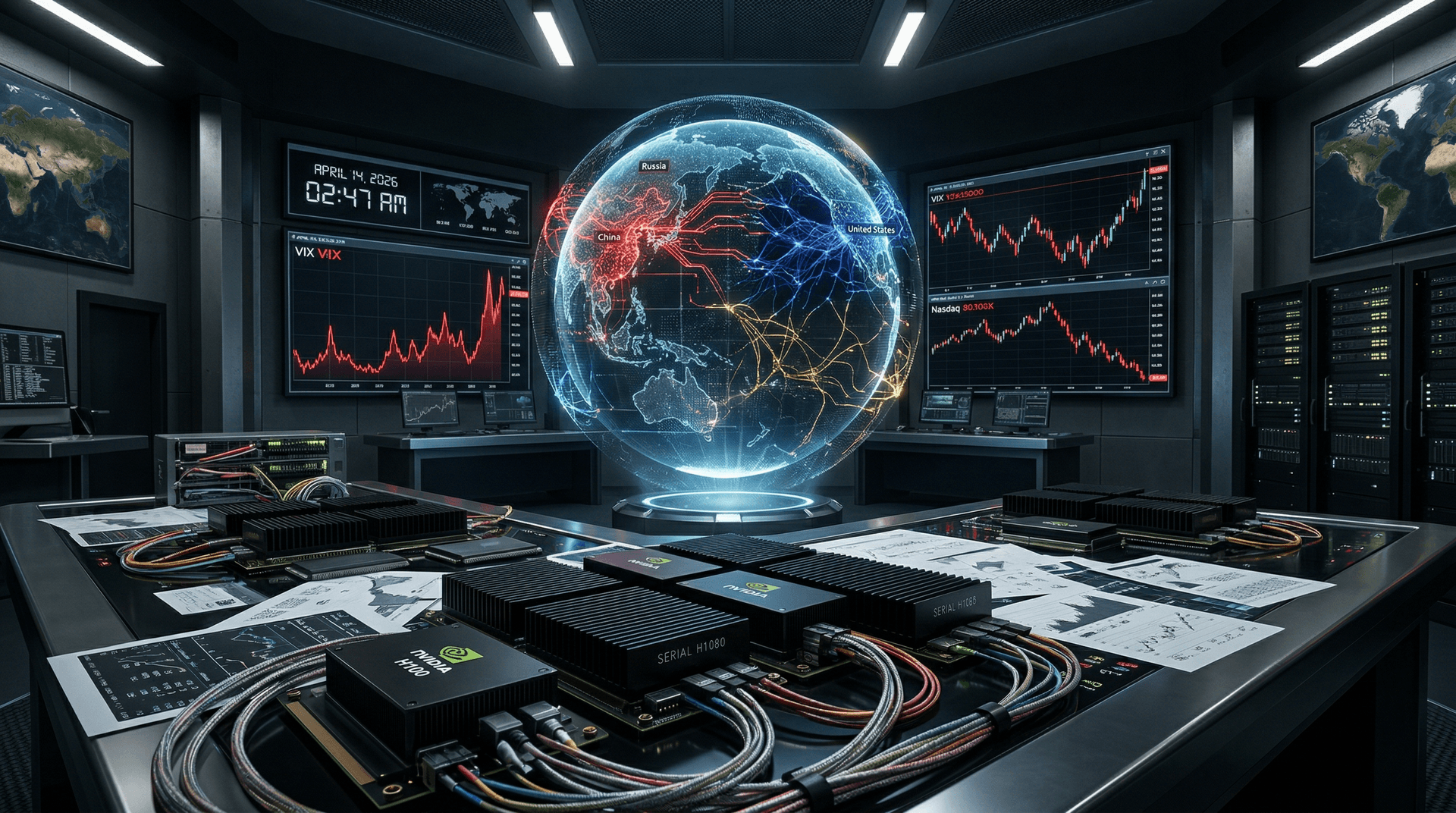
AI geopolitics escalated April 14, 2026, with US export curbs on $200 billion advanced AI chips to China. Measures target Nvidia H100 and AMD Instinct accelerators.
The curbs block 70% of high-end GPU shipments, per Reuters March 26, 2025, analysis. Commerce Department officials cited national security risks from AI-enabled military applications, triggering immediate supply chain disruptions.
Commerce Department Targets Nvidia's China Sales
Nvidia commands 85% market share in AI training chips, per Bloomberg April 14, 2026, data. US firms now require licenses for exports exceeding 100 teraflops performance, slashing Nvidia's China revenue by 25% in Q2 estimates.
China's Huawei and SMIC face 18-month delays in 7nm production, per TSMC Q1 2026 filings. Paul Scharre, director at Center for a New American Security, stated: "These curbs accelerate US AI supremacy while forcing Beijing's decoupling."
Semiconductor supply chains reroute to Taiwan and South Korea. TSMC reports 15% capacity shift to US fabs by Q3 2026, boosting Arizona plant output by 20%.
Macro Impacts Strike Equities and Forex
Nasdaq Composite closed down 1.8% on April 14, 2026, per S&P Global data. Philadelphia Semiconductor Index fell 3.2%, with Nvidia shares dropping 4.5% to $145.20 USD.
Federal Reserve tracks inflation pass-through from chip scarcity via PCE index. Goldman Sachs economists forecast 0.5 percentage point US GDP uplift in 2026 from reshoring, offset by 1.2 point China slowdown, using IMF baseline models.
Yuan weakened 2.1% versus USD to 7.45, per Financial Times April 14, 2026, reports. Emerging market ETFs lost $12 billion in assets under management, per Morningstar flows.
Matthew Kroenig, Atlantic Council vice president, warned: "AI geopolitics now drives 30% of global trade tensions, eclipsing energy disputes."
China Counters with $150B AI Subsidies
Beijing pledged $150 billion in state subsidies for AI chips by 2028, per Xinhua state media. State-owned funds bought 20% stakes in Biren Technology and Moore Threads.
Export controls spur 35% R&D increase in quantum computing integration, channeling funds through National IC Fund. Elsa B. Kania, Institute for Strategic Dialogue fellow, noted: "China views these $200 billion curbs as catalyst for self-reliance, mirroring 2018 ZTE sanctions."
India and Vietnam emerge as neutral hubs. Vietnamese fabs attract $8 billion FDI from Intel and Qualcomm since January 2026, per Vietnam Ministry of Planning data.
AI Geopolitics Ripples into Commodities
China halts rare earth exports for US-bound wafers, spiking neodymium prices 12% to $85/kg USD, per London Metal Exchange April 14 close. Lithium carbonate futures rise 4% on EV-AI convergence, hitting $15,000/tonne.
European Central Bank projects 0.8 percentage point eurozone growth drag in 2026 from chip shortages, via HICP inflation channels. ASML cuts China guidance 22% to €7.5 billion EUR for FY2026.
Global AI capex reaches $1 trillion USD in 2026, per IDC Q1 estimates. Hyperscalers like Microsoft allocate 60% budgets to compliant US suppliers, lifting Intel capex 18%.
Central Banks Respond to Chip Crunch
Bank of Japan injects ¥5 trillion liquidity for chipmakers, targeting Tokyo Electron yields. Shares gain 2.7% on Nikkei close April 14, 2026.
People's Bank of China pumps RMB 2 trillion into tech bonds. Yield curve flattens 15 basis points, signaling stimulus pivot to counter GDP drag.
Investors rotate into defense tech. Raytheon and Lockheed Martin rise 5.1% on NYSE, capturing AI warfare premiums amid $50B backlog growth.
G7 Aligns on AI Geopolitics Forward Path
G7 finance ministers meet April 20, 2026, to harmonize AI export regimes. European Commission proposes €50 billion chip fund, modeled on US CHIPS Act.
Brookings Institution models project $200 billion curbs widen US-China AI gap to 40% by 2028. Failure to align allies risks fragmented standards and 5% global trade efficiency loss.
Monitor Nvidia's Q2 earnings May 28, 2026, for compliance revenue splits in this AI geopolitics era. A 10% China exposure cut signals market stabilization over prolonged volatility.