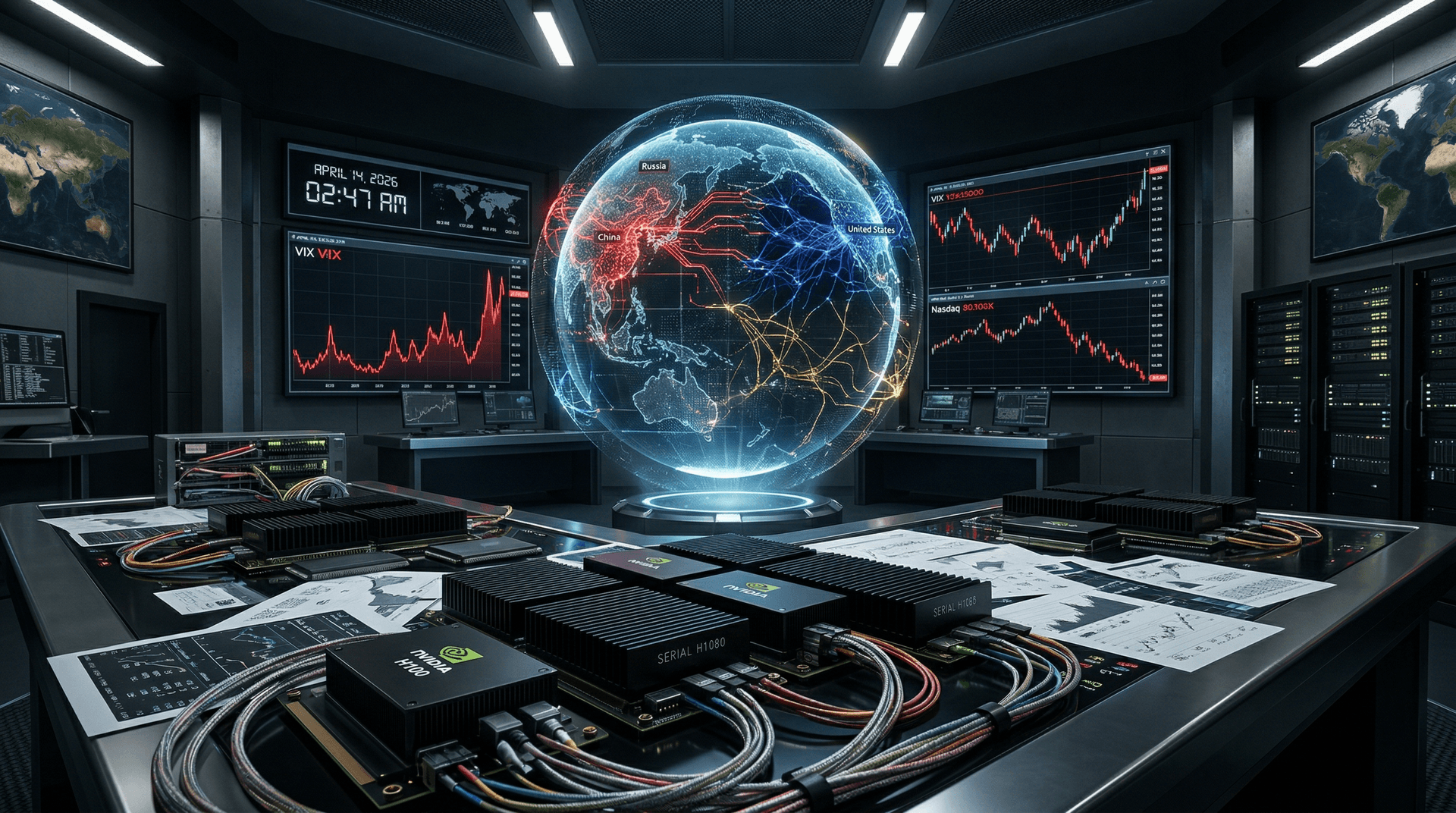
- Crypto Fear & Greed Index falls to 21 amid AI geopolitical tensions on April 14, 2026.
- US semiconductor exports to China decline 30% due to AI chip controls, per US Commerce Department.
- Global AI defense spending reaches $45 billion in 2026, according to SIPRI.
Key Takeaways
- Crypto Fear & Greed Index drops to 21 amid AI geopolitical tensions on April 14, 2026.
- US semiconductor exports to China fall 30% year-over-year, per US Commerce Department Q1 2026 data.
- Global AI defense spending hits USD 45 billion in 2026, per SIPRI.
AI Geopolitical Implications Plunge Crypto Fear & Greed Index to 21
AI geopolitical implications plunged the Crypto Fear & Greed Index to 21 on April 14, 2026. US-China tech rivalries intensified. Semiconductor exports to China dropped 30% year-over-year per US Commerce Department Q1 2026 data.
Nations treat AI as a strategic asset rivaling nuclear weapons. Analysts trace effects through supply chains and policy shifts. Bitcoin rose 5.0% to USD 74,482 in 24 hours per CoinMarketCap. Ethereum gained 7.9% to USD 2,367.10.
US AI Chip Bans Disrupt Semiconductor Supply Chains
US export controls halt advanced AI chips to curb China's military gains. NVIDIA flagged supply strains in its Q1 2026 earnings call on April 10.
Curbs caused the 30% export drop to China, US Commerce Department data confirms. Taiwan Semiconductor Manufacturing Company (TSMC) shifted production to allies. Bloomberg quantifies the US-China AI gap at 18-24 months, per Stanford's Matt Sheehan.
NVIDIA shares declined 2.1% to USD 125.40 on Nasdaq. PHLX Semiconductor Index (^SOX) fell 1.8% on April 14. Federal Reserve officials cited disruptions as inflation drivers, per March 2026 FOMC minutes.
China Accelerates AI Self-Sufficiency Investments
China committed RMB 1 trillion (USD 140 billion) to AI by 2030. Huawei deployed domestic 7-nm chips.
Baidu unveiled sovereign AI clouds. Domestic 7-nm output climbed 25% in Q1 2026, per China Semiconductor Industry Association. Georgetown's Ryan Fedasiuk highlights China's 1.4 billion population advantage for AI datasets.
Chinese AI startups raised USD 12 billion in Q1 2026 Series B+ funding, CB Insights reports. Yuan weakened 1.2% to 7.25 USD. Emerging market funds cut China holdings 5%, EPFR data shows.
EU AI Act Establishes Global Regulatory Standards
EU AI Act took effect April 14, 2026. It requires audits for high-risk systems like deepfakes and autonomous weapons. Fines reach 6% of global revenue.
Villanova's Deborah Seligsohn sees Europe setting standards. ASML redirected exports to compliant nations. Reuters outlines Q3 2026 enforcement.
Eurozone peripheral bond yields rose 15 bps to 3.2%. ESG funds shifted to EU-compliant tech. G7 aligned policies; Japan and South Korea echoed US curbs. Vietnam FDI jumped 20%, UNCTAD Q1 data.
AI Arms Race Sparks Military Spending Surge
SIPRI pegs 2026 global AI defense spending at USD 45 billion, US at USD 15 billion. Drones and cyber systems expand.
Israel deployed AI targeting. Russia upgraded electronic warfare. Eric Schmidt warns of AI arms race risks in Foreign Affairs.
Defense stocks climbed 3.4%; Lockheed Martin rose 2.7% to USD 520. China rare earth prices surged 8% to USD 45/kg, Argus Media.
Markets Show Volatility from AI Geopolitical Implications
Crypto diverged: BNB up 3.6% to USD 616.19; XRP up 3.3% to USD 1.37; USDT stable at USD 1.00. Blackstone launched USD 30 billion AI data center fund.
Fed eyes supply shocks; 2-10 Treasury curve steepened 8 bps. AI leaders trade at 45x forward P/E, FactSet.
Governance Challenges in AI Geopolitical Implications
US rallies Quad on standards; BRICS builds alternatives. AI clauses raise dual-use tariffs 15%.
TSMC forecasts 10% revenue hit in Q1 outlook. Financial Times maps alliance shifts. June 2026 G7 AI summit may unify rules or fracture trade, boosting volatility.