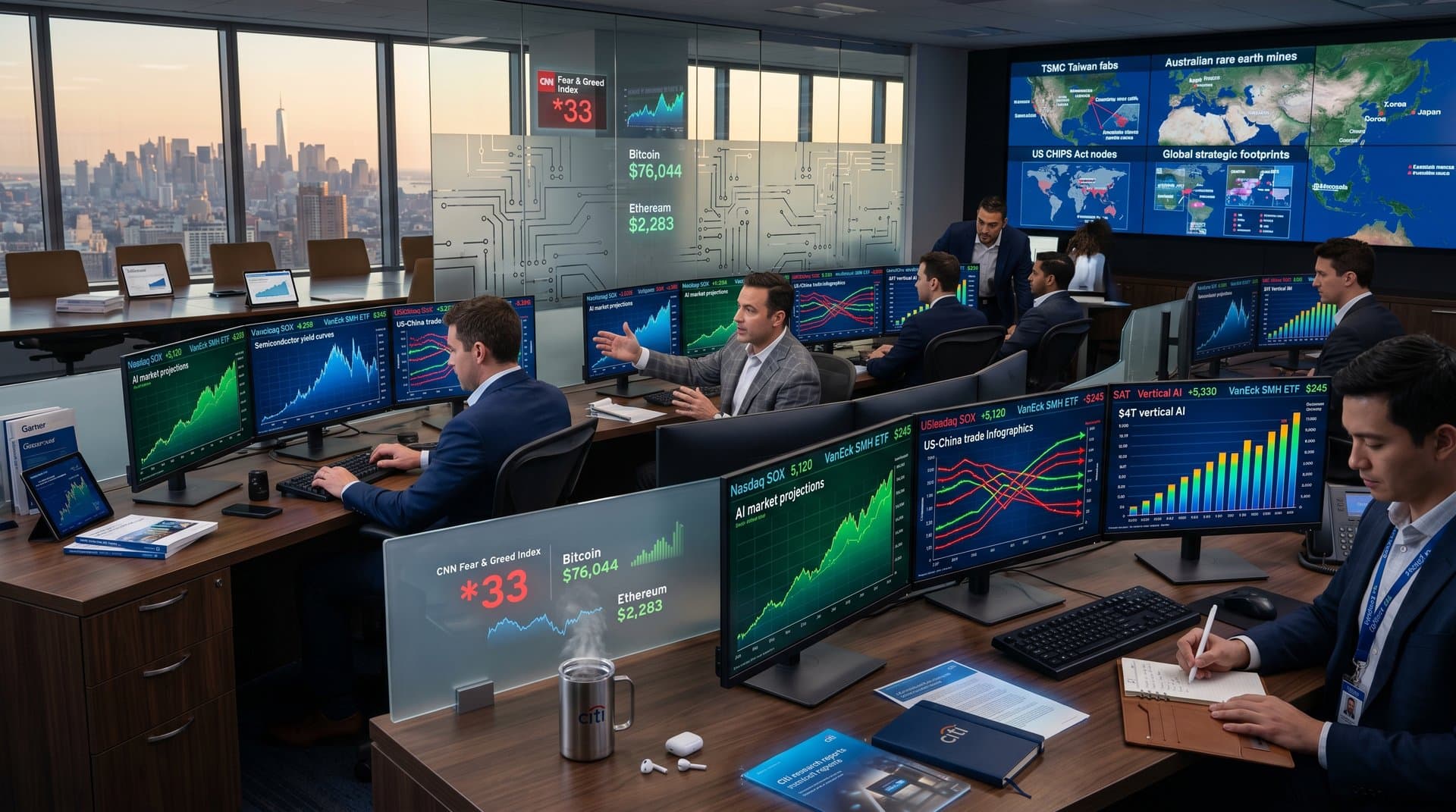
- Citi's $4T AI projection targets $4 trillion via enterprise tools.
- Fear & Greed Index falls to 33 on chip tension fears.
- Bitcoin at USD 76,044; semis rally 1.2-3.4% on diversification.
Citi projects a $4 trillion AI market fueled by enterprise adoption, defying US-China chip tensions (PYMNTS.com, October 2025). CNN Fear & Greed Index sits at 33. Bitcoin trades at USD 76,044, down 0.8% (CoinMarketCap, October 20, 2025).
Nasdaq Semiconductor Index (SOX) climbed 1.2% to 5,120 on AI demand (Yahoo Finance, October 20, 2025). Ethereum steadied at USD 2,283 (up 0.1%). XRP dropped to USD 1.38 (down 1.0%). Enterprises deploy AI for supply chain optimization.
Enterprise AI Growth Powers Citi's $4T Projection
Enterprises embed AI into core operations, boosting productivity in finance, manufacturing, and logistics. Citigroup cut risk-assessment costs 18% using AI (Citi Q3 2025 earnings call, October 15, 2025). Citi forecasts 15-20% efficiency gains from AI deployment.
AI investments weather volatility. Supply chain AI reroutes flows to EU and Japan, cutting delays 25% (Gartner Magic Quadrant, Q3 2025). Ethereum's USD 2,283 price supports decentralized compute, hedging GPU scarcity.
McKinsey projects AI adds 1.2 percentage points to global GDP by 2030 through enterprise use (McKinsey Global Institute, September 2025 report). This mechanism compresses unit labor costs, countering inflation.
Deloitte concurs: AI drives 16% capex growth in enterprises (Deloitte Tech Trends 2025, Q4 preview).
US-China Chip Geopolitics Disrupts AI Supply Chains
US export controls since October 2022 halted USD 15 billion in advanced chips to China (US Commerce Department, Q3 2025). NVIDIA's China sales fell 25% year-over-year (Reuters, October 15, 2025).
Enterprises shoulder 10-15% hardware cost hikes. China accelerates domestic fabs, fragmenting markets. TSMC produces 92% of leading-edge chips (TSMC Q3 2025 earnings, October 17, 2025), prompting US stockpiles.
Rare earth output shifts to Australia, up 30% (US Geological Survey Mineral Commodity Summary 2025). CHIPS Act allocates USD 52 billion for US fabs (US legislation 2022; Q3 2025 disbursements).
VanEck Semiconductor ETF (SMH) surged 3.4% to USD 245 on diversification plays (Bloomberg Terminal, October 19, 2025).
Citi's $4T Projection Enhances Macro Resilience
Enterprise AI counters sector shocks. Federal Reserve Chair Jerome Powell cited AI productivity gains at Jackson Hole, eyeing 0.5-1% disinflation (Federal Reserve transcript, September 2025).
Citi views AI as a trade disruption buffer. USDT stablecoin pegs at USD 1.00, enabling AI payment systems.
Bloomberg details hybrid cloud-edge AI models slashing latency 40% in restricted zones (Bloomberg, January 20, 2026).
EU AI Act (August 2025) regulates high-risk systems. G7 tech pacts cut multinationals' costs 5-10% (Citi Q4 2025 estimates).
Policy Responses Shape $4T AI Trajectory
US Quad boosts Japan-South Korea chip capacity 20% (Quad capacity report, Q3 2025). Enterprises implement AI governance for compliance edges.
Citi's $4T AI projection hinges on enterprise momentum. New US export rules test supply chains, but R&D spending rose 12% year-over-year (OECD STI Scoreboard, Q3 2025). Markets watch Fed's November 2025 meeting for AI signals.
Frequently Asked Questions
What is Citi's $4T AI projection?
Citi forecasts a $4 trillion AI market from enterprise efficiency tools (PYMNTS, 2025). Targets finance and manufacturing for macro resilience.
How do US-China chip tensions affect Citi's $4T AI projection?
Controls block USD 15B chips (Commerce Dept, Q3 2025), hiking costs 10-15%. Firms diversify to Japan-EU (Gartner, 2025).
Why does enterprise AI enhance macro resilience?
Delivers 15-20% gains (Citi Q3 2025); adds 1.2% to GDP (McKinsey 2025). Fed sees disinflation (Powell, September 2025).
What policy measures support AI growth amid geopolitics?
CHIPS Act USD 52B; EU AI Act; G7 pacts cut costs 5-10% (Citi Q4 2025). Quad lifts capacity 20%.