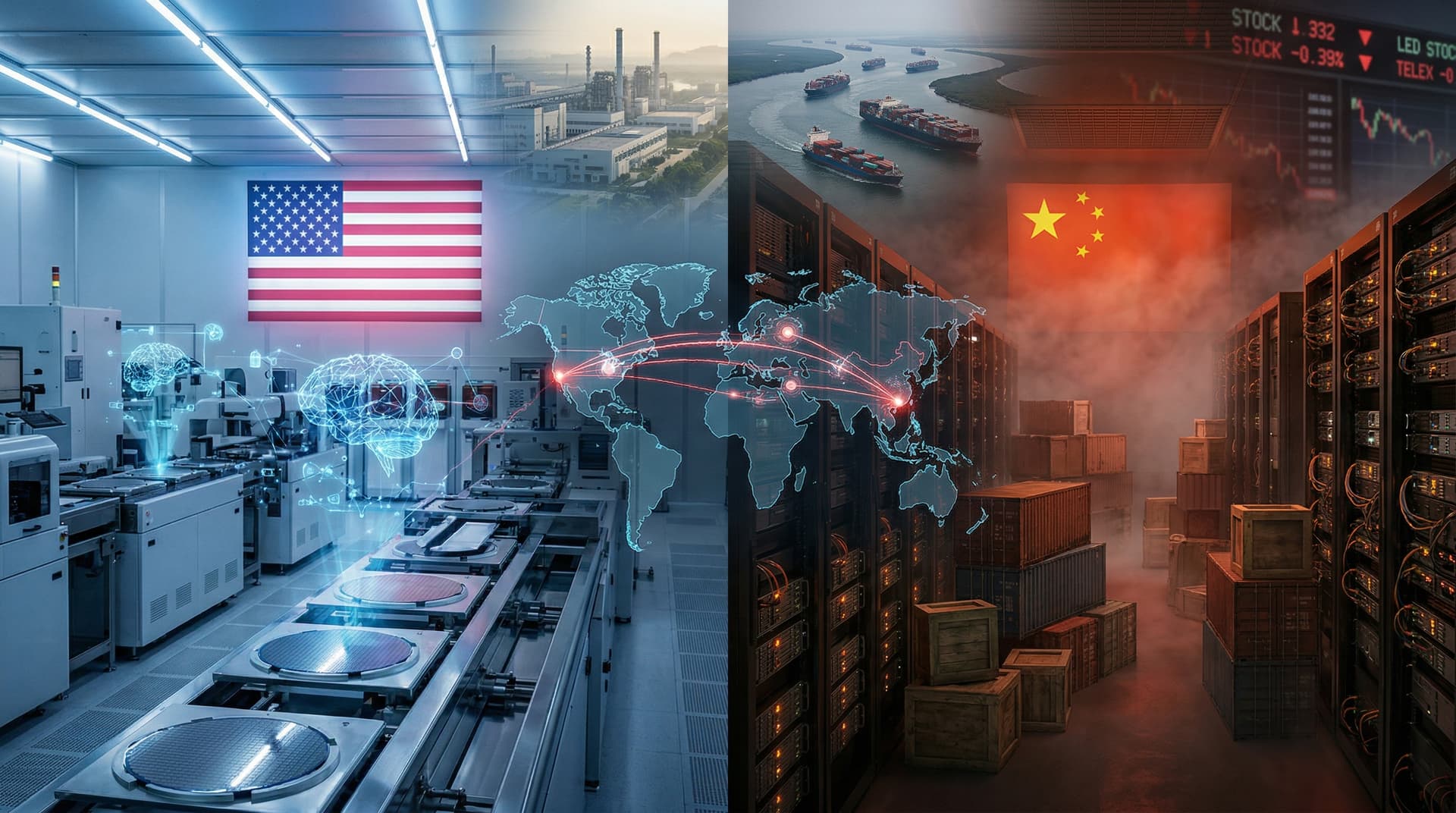
- US semiconductor exports to China face 35% controls, delaying Beijing's AI supercomputer builds by 24 months.
- Global chipmakers' shares plunge 5.2%, per Bloomberg data on April 13, 2026.
- China's domestic chip output rises 28%, yet lags US tech by 18 months according to CSIS.
Key Takeaways
- US semiconductor exports to China face 35% controls, delaying Beijing's AI supercomputer builds by 24 months.
- Global chipmakers' shares plunge 5.2% on SOX index, per Bloomberg data April 13, 2026.
- China's domestic chip output rises 28% in Q1 2026, yet lags US tech by 18 months per CSIS.
AI geopolitics escalates. The US Department of Commerce imposed 35% controls on semiconductor exports to China on April 13, 2026. These target advanced GPUs critical for AI models.
Officials cite national security risks from China's military AI applications. The curbs extend prior limits on Nvidia and AMD products.
Export Controls Target AI Hardware Chokepoints
The rules restrict GPUs exceeding 3,000 teraflops. Commerce Secretary Gina Raimondo announced them in Washington, DC.
"These measures safeguard US innovation leadership," Raimondo stated. Nvidia Corp. (NVDA) and Advanced Micro Devices Inc. (AMD) must comply immediately.
Brookings Institution Senior Fellow Robert Blackwell analyzes effects. "China's access to high-end AI chips drops sharply," Blackwell told Reuters. Large language model training slows by 18-24 months.
Semiconductor Industry Association report shows US chip exports to China reached USD 12.4 billion in 2025, per US Census Bureau data. The 35% cut blocks USD 4.3 billion annually, or 2.1% of total US semiconductor exports.
China Accelerates Domestic AI Chip Push
China's Ministry of Commerce calls the curbs "economic coercion" and vows retaliation.
Beijing budgets USD 50 billion for semiconductors in 2026, per state plans. Huawei Technologies launches Ascend 910C chips for AI workloads.
Eurasia Group Lead Analyst Dan Wang assesses advances. "China ramps 7nm production but trails US 3nm nodes by two generations," Wang notes in a client report. Full parity demands three years.
SMIC reports 28% output growth in Q1 2026, seasonally adjusted per company filings. State media claims 70% of AI data centers now use domestic hardware, up from 45% in 2025.
AI Geopolitics Shock Tumbles Markets
Nasdaq Composite fell 2.8% on April 13, 2026. The Semiconductor Select Industry Index (SOX) plunged 5.2%, Bloomberg data shows.
Nvidia shares dropped 7.1% after hours to USD 128.45. Goldman Sachs cuts 2026 revenue forecasts 12% to USD 145 billion, citing China exposure.
US urges Taiwan Semiconductor Manufacturing Co. (TSM) to limit China shipments. TSMC stock dipped 4.3% in Taipei trading.
CNN Business Fear & Greed Index hit 12, signaling extreme fear. Investors shifted to bonds; 10-year Treasury yields fell to 3.92%, per US Treasury data.
Supply Chains Reroute to Southeast Asia
Electronics firms shift production amid curbs. Vietnam attracts USD 8.2 billion in chip FDI since 2025, per Vietnamese Investment Board.
Intel expands Malaysia fabs by 20%. Samsung increases India output 22% in Q1 2026.
Deputy Secretary of State Kurt Campbell warns of decoupling risks. "AI leadership demands secure supply chains," Campbell told Reuters. IMF models estimate full US-China tech split costs 1.2% of global GDP annually.
Central Banks Monitor Chip Shortage Inflation
Federal Reserve Chair Jerome Powell flags risks. Shortages could add 0.4% to US CPI in H2 2026, per FOMC minutes.
European Central Bank highlights eurozone vulnerabilities. German automakers face AI sensor delays, risking 0.3% GDP drag per Ifo Institute.
Bank of Japan holds rates at 0.25%. Yen strengthened 1.2% versus USD on safe-haven flows, Bank of Japan data shows.
Corporates Stockpile Amid Semiconductor Curbs
Microsoft (MSFT) and Amazon (AMZN) hoard compliant chips. Google relocates AI training to US data centers.
OpenAI projects 15% inference cost increases. CEO Sam Altman lobbies for exemptions to maintain competitiveness.
Baidu deploys hybrid AI models using domestic GPUs and cloud proxies.
Allies Coordinate AI Geopolitics Response
Netherlands restricts ASML extreme ultraviolet lithography exports to China.
Japan curbs chip equipment sales. Quad alliance (US, Japan, India, Australia) launches AI supply chain pact April 12, 2026.
CSIS reports China's AI patents surged 42% yearly through 2025. Top models trail GPT-5 equivalents by 15% in benchmarks.
Enforcement Defines AI Geopolitics Trajectory
US Customs seized USD 1.2 billion in gray-market chips last quarter, per agency reports. Huawei's Kirin 9020 achieves 80% of Nvidia A100 performance on AI benchmarks.
A 50% export threshold could trigger full tech bifurcation in this AI geopolitics standoff. Beijing's April 20 AI summit previews scaled responses, per Xinhua.