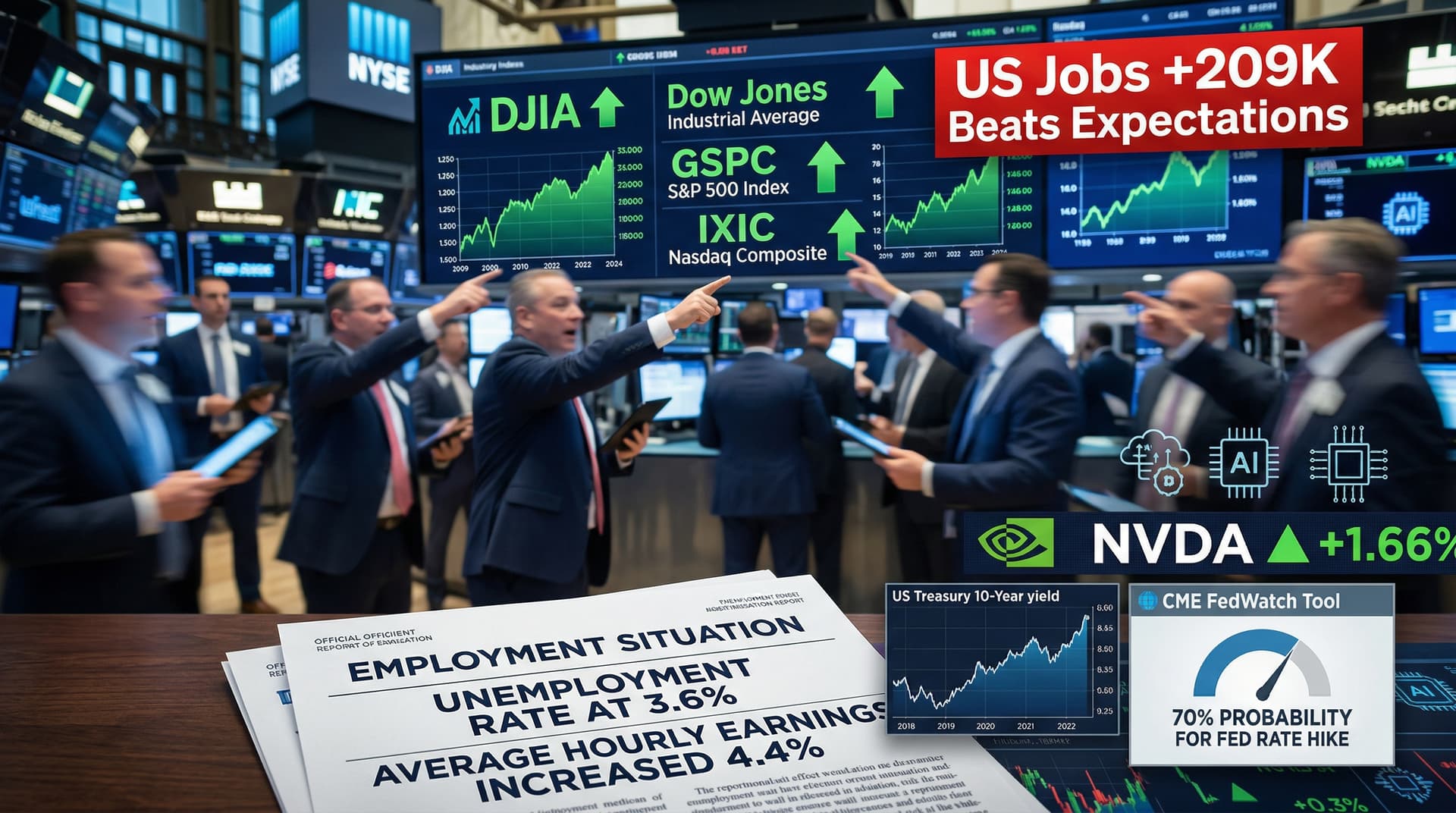
In a pivotal moment for markets, the US Bureau of Labor Statistics released its June nonfarm payrolls report on July 7, revealing a stronger-than-expected addition of 209,000 jobs. This figure handily beat economist consensus estimates of around 190,000, signaling the labor market's remarkable resilience in the face of the Federal Reserve's aggressive monetary tightening campaign. However, hotter-than-anticipated wage growth and significant downward revisions to prior months' data tempered the optimism, reigniting debates over the Fed's path forward.
Key Highlights from the Jobs Data
The unemployment rate held steady at 3.6%, in line with expectations and near historic lows. Labor force participation edged up slightly to 62.6%, while average hourly earnings accelerated to a 0.4% monthly gain—above the 0.3% forecast—and a 4.4% year-over-year increase, surpassing the anticipated 4.3%. These wage figures are particularly concerning for policymakers, as they suggest persistent inflationary pressures in a key component of the consumer price index.
Notably, the report included substantial downward revisions: May's job gains were slashed from an initial 339,000 to just 185,000, a 154,000 drop, while April's figure fell by 37,000 to 153,000. Overall, these adjustments shaved 110,000 jobs from the prior two months' totals, painting a slightly less rosy picture of momentum but still confirming a cooling yet robust labor market.
Sector breakdowns showed gains led by leisure and hospitality (+70,000), professional and business services (+53,000), and government (+56,000). Manufacturing lost 3,000 jobs, reflecting ongoing headwinds, while tech-related sectors like information services added modestly amid the broader AI enthusiasm.
Market Reaction: Rally with Caution
Equities surged on the release. The Dow Jones Industrial Average climbed 443 points, or 1.2%, to 34,502. The S&P 500 rose 1% to 4,443, and the Nasdaq Composite gained 1.5% to 13,680, propelled by Big Tech names. Nvidia, riding the AI wave, jumped over 3%, while Microsoft and Apple each advanced around 2%. The small-cap Russell 2000 outperformed with a 2.6% leap, hinting at broadening market participation.
Bonds sold off sharply, with the 10-year Treasury yield spiking 12 basis points to 4.01%, its highest since June 13. This reflected repricing for sustained higher-for-longer rates. CME FedWatch Tool probabilities shifted dramatically: the odds of a 25 basis point September hike jumped from about 30% pre-report to over 70%, with December odds also rising.
"The data was a Goldilocks report—not too hot, not too cold—but the revisions and wages add spice," noted Ian Lyngen, senior strategist at BMO Capital Markets. Investors now grapple with soft-landing hopes versus recession risks.
Powell's Testimony Reinforces Hawkish Stance
Fed Chair Jerome Powell's semiannual congressional testimony on July 10 amplified the hawkish undertones. Speaking before the House Financial Services Committee, Powell emphasized that the economy remains strong, with a "low likelihood" of recession despite 10 rate hikes since March 2022, bringing the federal funds rate to 5.25-5.50%.
"We are well aware that the current destination is higher interest rates," Powell stated, underscoring data-dependent policy but cautioning against premature easing. He highlighted balanced risks but noted upside inflation surprises and a tight labor market as key concerns. Markets interpreted this as a green light for at least one more hike, potentially in September or later.
This comes amid mixed signals: ISM services PMI on July 5 plunged to 43.9, its lowest since February 2020, indicating contraction in that vast sector. Yet jobs data overrides, keeping hike bets alive.
Implications for Tech and Broader Markets
As a tech-focused observer, the report's ripple effects on Silicon Valley are telling. Strong consumer spending power—bolstered by low unemployment and wage gains—supports Big Tech's ad revenues and cloud growth. AI darlings like Nvidia benefited, with its market cap nearing $1.1 trillion post-rally, as economic resilience fuels capex on data centers and chips.
However, higher yields pressure growth stocks' valuations. The Nasdaq's P/E ratio, already stretched, faces headwinds if rates climb further. Regional banks, still smarting from March turmoil, saw shares mixed; while large banks passed the Fed's July 10 stress tests with flying colors—JPMorgan's CET1 ratio at 10.6% under severe scenarios—the smaller players remain vulnerable to deposit outflows in a high-rate world.
Globally, the data bolstered the dollar, with the DXY index up 0.5%. European markets followed suit, though China's weak Caixin services PMI (released July 3 at 49.5) underscores divergent recoveries. Geopolitical tensions, including NATO's Vilnius summit underway, add macro uncertainty, but US strength dominates.
Macro Outlook: Soft Landing in Sight?
The June CPI (reported June 13) showed core inflation at 4.8% y/y, down from peaks, but sticky services and shelter costs persist. PCE data due later this week will be watched closely. If labor cools gradually without cracking, the Fed could pivot by year-end.
Analysts like Goldman Sachs now see a 25bp hike in September (probability 65%), holding through Q4. Recession odds have dipped to 15% per NY Fed models. Yet, downside risks loom: consumer debt at records, corporate earnings warnings (Delta Air Lines flagged demand softening), and housing market freeze.
For investors, diversification reigns: rotate into value, small-caps, and cyclicals. Tech remains a hold for AI secular trends, but trim multiples if yields hit 4.25%.
Final Thoughts
July's jobs report reaffirms the US economy's fortitude, delighting equity bulls while tormenting bond vigilantes. As Powell signals no pivot yet, markets brace for volatility. In this high-stakes chess game, data reigns supreme—watch July CPI on July 12 for the next move.
(Word count: 912)