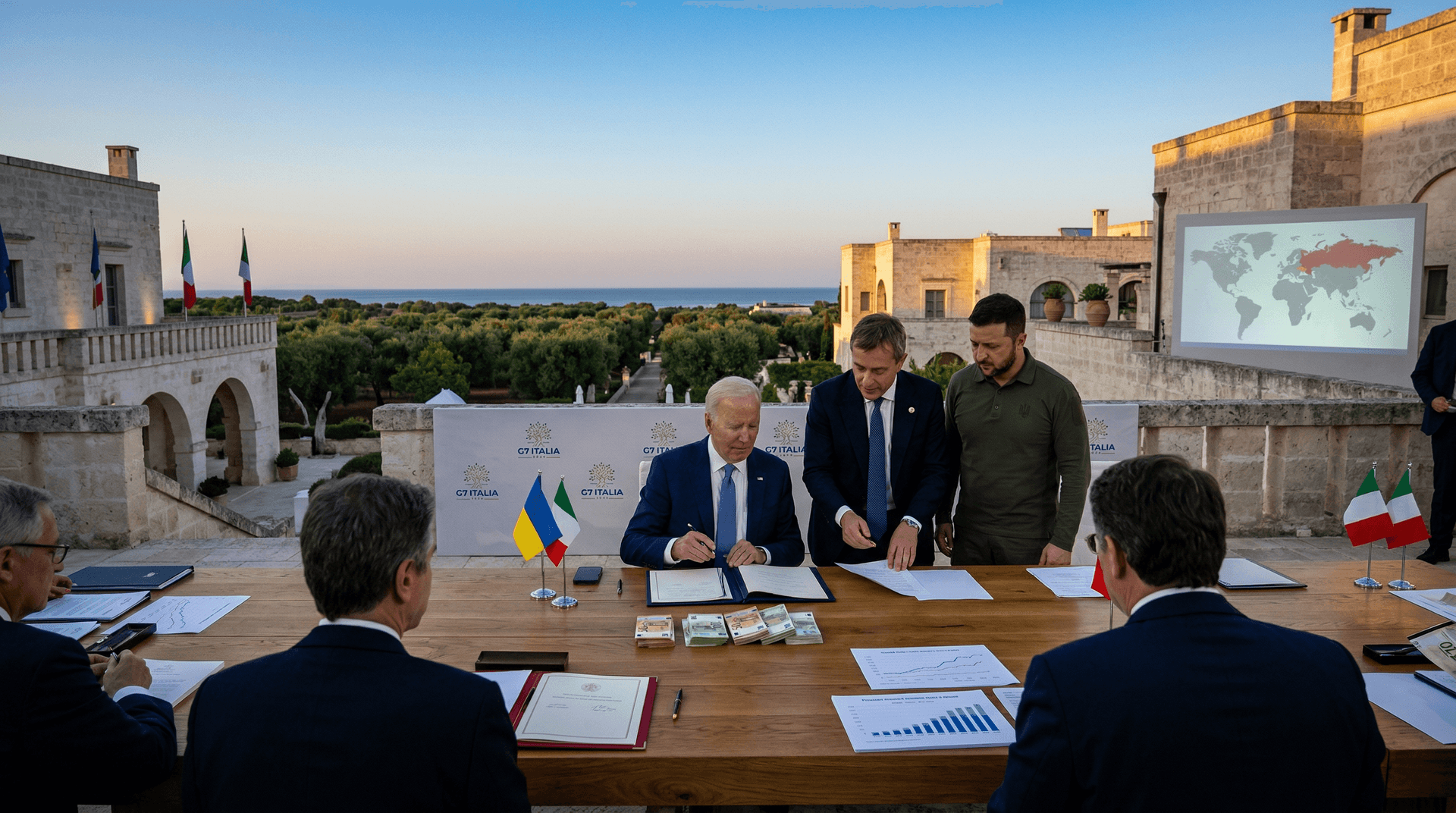
The Group of Seven (G7) nations took a groundbreaking step at their annual summit in Borgo Egnazia, Puglia, Italy, from June 13-15, 2024. In a communique released on June 13, the leaders pledged to mobilize approximately $50 billion in loans for Ukraine, backed by the extraordinary revenues generated from frozen Russian sovereign assets. This policy decision represents one of the most audacious financial maneuvers in modern geopolitics, repurposing windfall profits from sanctioned Russian funds to sustain Kyiv's war effort against Moscow's invasion.
Background: Assets Frozen, Tensions Simmering
Since Russia's full-scale invasion of Ukraine in February 2022, Western nations have imposed sweeping sanctions, including the immobilization of around $300 billion in Russian central bank reserves held primarily in Europe. The European Union holds about €210 billion ($225 billion), with the rest scattered across G7 jurisdictions like the U.S., U.K., Japan, and Canada. These assets, mostly in Euroclear (Belgium), have been generating interest—estimated at €3 billion ($3.2 billion) annually—sitting idle amid legal and diplomatic debates.
Previous discussions centered on outright confiscation, but concerns over precedent-setting seizures of sovereign assets deterred consensus. Instead, the G7 opted for a loan structure: Borrow against future interest revenues, repayable from any post-war Russian reparations. U.S. Treasury Secretary Janet Yellen championed the framework, arguing it provides immediate aid without direct expropriation, thus mitigating retaliation risks like asset freezes on Western holdings abroad.
Summit Dynamics and Key Players
Hosted by Italian Prime Minister Giorgia Meloni, the summit drew U.S. President Joe Biden, who arrived amid domestic political turbulence from his recent debate performance. Ukrainian President Volodymyr Zelenskyy attended, securing verbal commitments despite U.S. congressional delays on a $61 billion aid package. The final deal bridges that gap short-term, with contributions proportional to asset holdings: Europe footing most via EU mechanisms.
The communique emphasized unity: "We will launch a mechanism to provide Ukraine with unprecedented financial support, using future extraordinary revenues from these immobilized Russian sovereign assets." This follows bilateral pledges, like the U.S. $20 billion tranche in April, but scales up multilaterally.
Market Reactions: Stability with Underlying Volatility
Global markets greeted the news with measured optimism. European stocks rose modestly on June 14, with the STOXX 600 up 0.5%, buoyed by reduced Ukraine funding uncertainty. Oil prices dipped slightly, as sustained Western support signals no imminent de-escalation, pressuring Russia's war economy already strained by 16% interest rates and 7.4% inflation (May data).
The ruble strengthened marginally against the dollar, reflecting Moscow's dismissal of the plan as "theft." Broader macro implications loom: Heightened geopolitical risk premia could keep energy prices elevated, supporting U.S. shale but challenging Europe ahead of winter. Bond yields ticked up in G7 nations, as investors price in fiscal expansion for defense spending—U.S. deficit at 6.4% of GDP, EU fiscal rules under strain.
Currency markets showed resilience; the euro held above $1.07, underscoring ECB hawkishness post-June 6 rate cut to 4.25%. Yet, experts warn of contagion: If Russia retaliates by seizing foreign assets (it holds $270 billion abroad), it could spark a cascade in emerging markets.
Policy Implications: Precedent and Pushback
This isn't mere aid—it's financial warfare evolution. By avoiding outright seizure, G7 sidesteps violations of international law (e.g., 1907 Hague Conventions), but critics like Russian Foreign Minister Sergey Lavrov decry it as "banditry." Legal scholars note enforceability hinges on Ukraine victory; default risks burdening G7 taxpayers.
Geopolitically, it pressures Putin ahead of potential Trump return in November, who has vowed quicker peace talks. China, absent but criticized in the communique for "non-market practices," watched warily—its dual-use exports to Russia persist despite sanctions.
Domestically, challenges abound. In the U.S., Republican hawks like Senator Lindsey Graham back it, but isolationists balk at endless commitments. Europe's far-right surge post-EU elections (June 6-9) complicates execution; France's Macron called snap polls after losses, Hungary's Orban dissents.
Broader Macro Ramifications
Fiscal policy intersects macro here. G7 nations, grappling post-COVID debt (U.S. 120% GDP, Japan 260%), commit amid slowing growth. IMF projects global 3.2% in 2024, but Ukraine war shaves 0.5 points via energy shocks. This $50 billion (~0.04% global GDP) sustains reconstruction too, per World Bank estimates of $486 billion needed by 2025.
Monetary policy divergence amplifies: Fed holds at 5.25-5.5% (June 12), ECB cuts, BOJ exits zero rates June 14. Asset deal indirectly supports disinflation by stabilizing supply chains, aiding Powell's soft landing narrative (CPI 3.3% YoY June 12).
Trade policy ties in: G7 bashed China's EV overcapacity, echoing Biden's tariffs (100% on Chinese EVs May 14). Ukraine aid reinforces de-risking from Russia, boosting critical minerals pacts.
Looking Ahead: Risks and Opportunities
Implementation timelines target summer 2024, with EU trusteeship likely. Success hinges on unity; Biden's age (81) and election risks add uncertainty. Markets eye Russian countermeasures—cyber, energy—or escalations like deeper Ukraine incursions.
Optimists see it accelerating peace via leverage; pessimists fear prolongation, inflating defense budgets (NATO 2% pledge nears universality). For investors, it's a buy signal for defense (RTX, Lockheed up 20% YTD) and commodities.
In sum, G7's asset gambit fuses policy innovation with realpolitik, reshaping macro fault lines. As Yellen noted, "It's the right thing, and feasible." Whether it endures war's grind remains the test.
(Word count: 912)