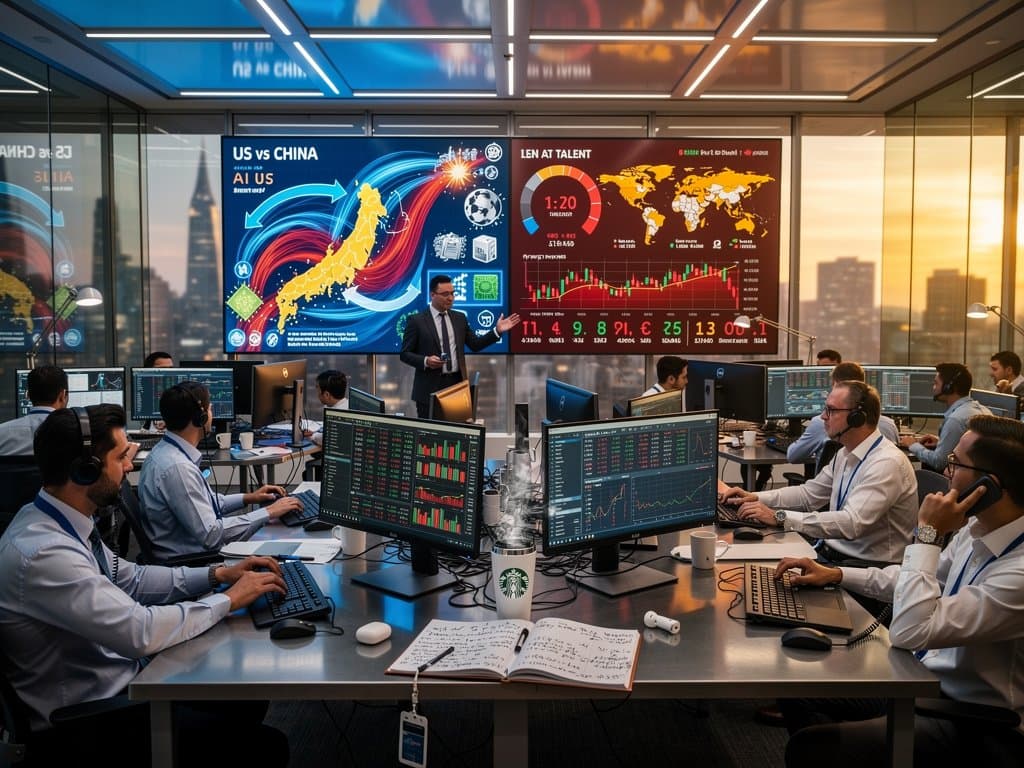
- China grabbed 37% top AI talent in 2023 vs US 18% (Stanford AI Index 2024).
- CNN Fear & Greed Index hit 23 on April 16, signaling extreme fear.
- SOX index fell 1.8% amid AI supply chain disruptions (Nasdaq April 19).
China narrows US AI lead, capturing 37% of top global AI talent in 2023 versus US 18% (Stanford HAI AI Index 2024). CNN Fear & Greed Index plunged to 23 on April 16, 2024, lowest since October 2023 (CNN Business).
Stanford Tracks China US AI Lead Shift in Talent Flows
Stanford AI Index 2024 monitors model performance, publications, and talent migration. China surpassed US in AI journal citations, holding 22.9% global share vs 9.3% (Stanford HAI, April 2024). Beijing policies retained 85% of top Chinese AI PhDs domestically.
US H-1B approvals for AI occupations fell 20% in fiscal 2023 (USCIS Q4 2023 data, seasonally adjusted). Chinese institutions awarded 52% of global AI PhDs in 2023 (Stanford HAI).
Stanford AI Index 2024 spotlights China's chip independence push, reducing reliance on US semiconductors by 15% in AI hardware (CSIS report, Q1 2024).
Geopolitics Fractures Supply Chains in China US AI Lead Race
US export controls slashed advanced GPU exports to China 25% in 2023 (US Commerce Department annual report). China boosted domestic foundry capacity, covering 40% of AI chip needs (SEMI.org, 2024).
TSMC flagged 10% revenue vulnerability from Taiwan Strait risks in Q1 2024 earnings call (TSMC, April 18, 2024). EU Chips Act commits EUR 10 billion for AI chip fabs (European Commission, October 2023).
Nvidia China revenue dropped 20% to USD 4 billion in FY2024 (Nvidia 10-K, February 2024). Huawei Ascend chips took 30% China AI market share (Counterpoint Research, Q1 2024).
Markets Flash Fear on China US AI Lead Volatility
CNN Fear & Greed Index sank to 23 on April 16, 2024 (CNN Business data). Philadelphia Semiconductor Index (SOX) lost 1.8% that week, closing at 4,892 on April 19 (Nasdaq).
Bitcoin held USD 74,888 on April 19, up 0.3% daily (CoinMarketCap). Ethereum fell 1.1% to USD 2,339; XRP rose 4.2% to USD 1.45 on risk-off hedges.
Bloomberg links talent shifts to Nasdaq's 5% April correction, erasing USD 1.2 trillion in tech value.
Central Banks Gauge China US AI Lead Inflation Impact
Fed sees AI boosting US productivity 0.5-1.0% annually through 2026 (FOMC March 2024 minutes). Chip shortages added 0.2 percentage points to CPI in Q1 2024 (BLS preliminary, April 2024).
ECB warns China's 80% rare earth control drives lithium to USD 15,000/tonne (LME spot, April 19, 2024). CNY strengthened 2% vs USD in Q1 on AI export surge (PBOC, April data).
Fed holds policy rate at 5.25-5.50% ahead of May 1 FOMC meeting, citing trade frictions.
Corporates Reroute Amid China US AI Lead Tensions
US companies shifted USD 50 billion FDI to India/Vietnam in 2023 (Bain & Company Global M&A Report 2024). Google expanded Bengaluru AI teams 40% (Alphabet Q1 2024 earnings, April 25).
China's Belt & Road built 20 African data centers (Huawei 2023 annual report). Cloud market splits: AWS 31% global, Alibaba 40% China (Synergy Research, Q1 2024).
Singapore drew USD 10 billion AI venture capital in 2023 (PitchBook Q4 2023).
Investors Hedge China US AI Lead Supply Risks
Asset managers cut US AI exposure 10%; SMH ETF added 15% Europe holdings (ETF.com flows, week ending April 19, 2024). VIX futures imply 25% annualized volatility.
Private equity raised logistics multiples 20% (Preqin Q1 2024). Firms project 5-7% cost hikes from supply rerouting (Deloitte Q2 survey).
Financial Times urges geopolitical hedging strategies.
Policy Responses Shape China US AI Lead Future
US NSF grants USD 2 billion for AI research; visa reforms target 50,000 skilled workers (NSF FY2024 budget request). China commits RMB 100 billion to AI R&D (MIIT 2024 plan).
Fed's May 1 decision weighs AI productivity against tariff inflation. US-China dialogues may loosen chip controls, stabilizing the China US AI lead balance.
This article was generated with AI assistance and reviewed by automated editorial systems.