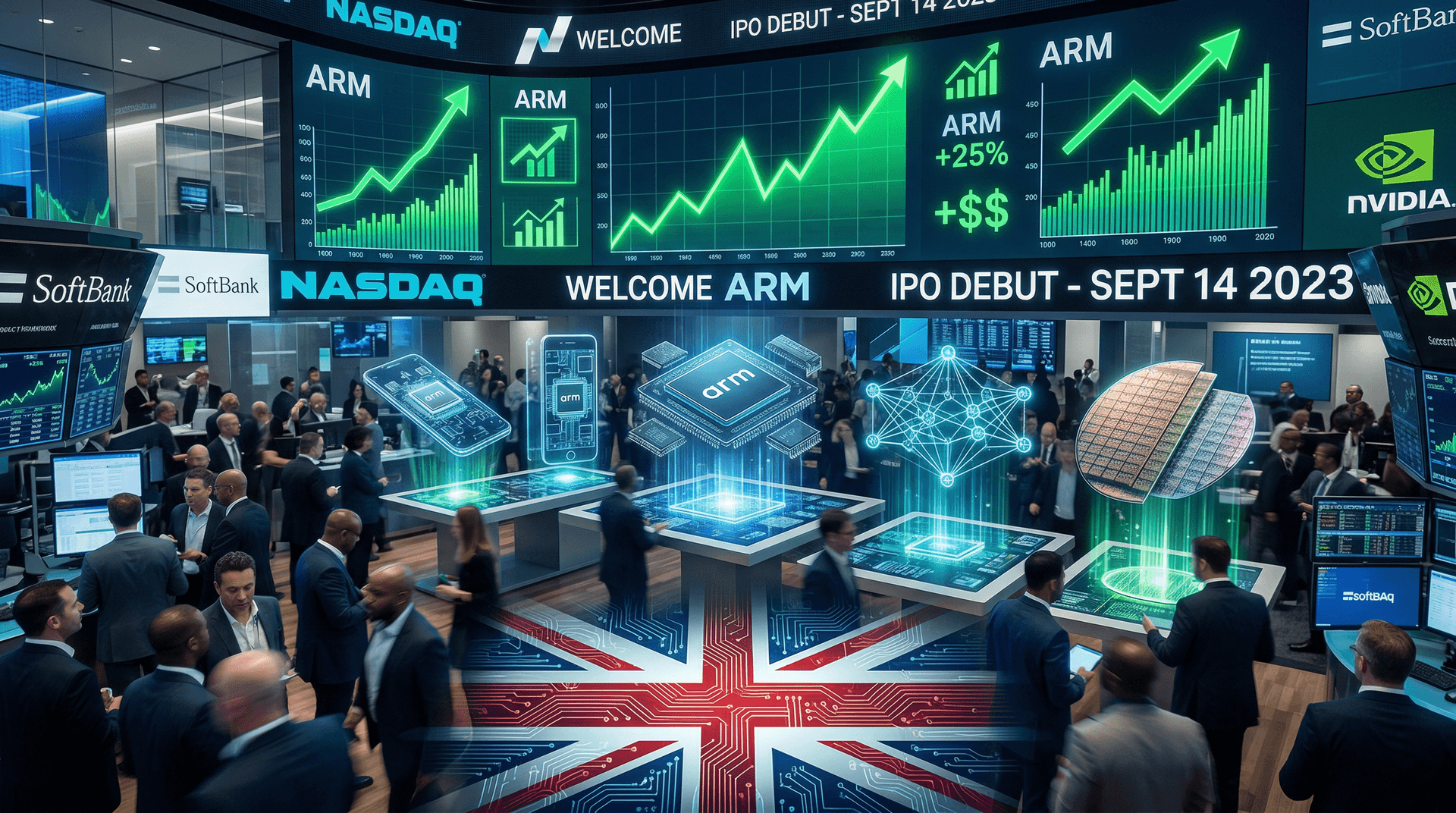
In a blockbuster move for the tech IPO market, Arm Holdings plc priced its initial public offering at $51 per share late on September 13, 2023—the high end of its expected range of $47 to $51. This values the Cambridge, UK-based semiconductor design powerhouse at approximately $54 billion on a fully diluted basis, making it one of the largest tech listings since 2021. The offering includes 95.5 million American Depositary Shares (ADS), with underwriters like Goldman Sachs, J.P. Morgan, and Barclays holding a 30-day option for an additional 14.3 million shares.
Arm's return to public markets comes seven years after its parent company, Japan's SoftBank Group, took it private in a $32 billion deal. The IPO represents a pivotal moment for SoftBank, which has been grappling with valuation pressures from its Vision Fund losses amid a tech downturn. Proceeds will bolster SoftBank's balance sheet, potentially funding further AI investments. Masayoshi Son, SoftBank's CEO, has long championed Arm as the "crown jewel" of his empire, citing its royalty-based business model that generates steady cash flows from licensing processor architectures used in over 99% of smartphones worldwide.
The AI Tailwind Driving Demand
The timing couldn't be better. Arm's IPO arrives amid explosive demand for artificial intelligence technologies, where its energy-efficient chip designs are increasingly vital. While Arm doesn't manufacture chips, its instruction set architecture (ISA) powers designs from Nvidia, Apple, Qualcomm, and others. Nvidia's dominance in AI GPUs relies partly on Arm-based architectures for data centers, and Apple's shift to Arm-powered M-series chips has been a boon.
Investors piled into the IPO prospectus, drawn by Arm's fiscal 2023 revenue of $2.68 billion (up 32% year-over-year) and projections for 23% growth in the current year. Royalties, which account for about half of revenue, surged 58% last year, fueled by premium chip sales in smartphones and emerging AI edge devices. Analysts point to Arm's total addressable market expanding to $206 billion by 2030, spanning mobile, automotive, IoT, and data centers.
The IPO roadshow highlighted Arm's pivot toward AI and high-performance computing. CEO Rene Haas emphasized versions like Armv9, which command higher royalties (up to 5x legacy rates), and partnerships with AI leaders. This narrative resonated in a market where AI stocks like Nvidia have surged over 200% year-to-date, pushing the PHLX Semiconductor Index up 45%.
Market Context: From IPO Winter to Spring
Arm's listing caps a dormant period for tech IPOs. Since the 2021 peak, high interest rates and economic uncertainty sidelined deals. Only 14 venture-backed IPOs occurred in the US in the first half of 2023, per Renaissance Capital. But signs of thaw emerged: Instacart filed confidentially in August, and Klaviyo debuted strongly in September.
Broader markets provided tailwinds. The S&P 500 touched record highs above 4,500 this week, buoyed by August CPI data released September 13 showing headline inflation at 3.7% year-over-year—slightly above expectations but with core measures stabilizing. This softened Federal Reserve rate hike fears, with markets pricing a 99% chance of no hike at the September 19-20 FOMC meeting, per CME FedWatch.
Tech-heavy Nasdaq Composite climbed 1.4% on September 13, led by semiconductors. Arm's pricing reflects this optimism, with shares allocated to marquee investors like T. Rowe Price and Capital Group. Retail interest via platforms like Robinhood was robust, echoing 2021's meme-stock frenzy but grounded in fundamentals.
Geopolitical and Macro Headwinds
Yet risks loom. US-China tensions pose challenges; Arm derives 20-25% of royalties from Chinese licensees amid export curbs on advanced chips. Arm China, a joint venture, has been mired in disputes, prompting Beijing investigations. Diversification into data centers (now 10% of royalties) and automotive (projected $10B market) mitigates this.
Macro pressures include elevated rates—Fed funds at 5.25-5.50%—compressing growth multiples. Arm trades at a forward P/E of 80x, premium to peers like AMD (45x) but justified by 50%+ margins. Oil prices, up 3% this week after Saudi/Russia production cuts extended September 5, add inflation stickiness, potentially delaying rate cuts.
Globally, Europe's energy crisis and China's property woes dampen device demand, but AI's "supercycle"—projected $1 trillion in data center spend by 2030—overrides cyclicality.
What’s Next for Arm and Tech Markets?
Arm shares are set to debut September 14 on Nasdaq under ticker ARM. Pre-IPO trading indicated pops to $56+, suggesting a $60B+ valuation at open. A strong debut could catalyze more listings: Reddit, Stripe, and Databricks watch closely.
For semiconductors, Arm reinforces the sector's leadership. With foundry partner TSMC expanding capacity amid AI rush, supply constraints may ease. Investors eye Arm's 2025 guidance: 20%+ revenue growth, EPS doubling.
SoftBank gains firepower; its $160B Vision Fund 2, down 5% this year, could rebound. Son's Arm stake (90%) post-IPO remains a control vehicle.
In sum, Arm's IPO isn't just a listing—it's a referendum on AI's endurance amid macro volatility. If it soars, expect a flood of tech supply. If it falters, caution may prevail. Markets, geopolitics, and Fed path will decide.
Word count: 912