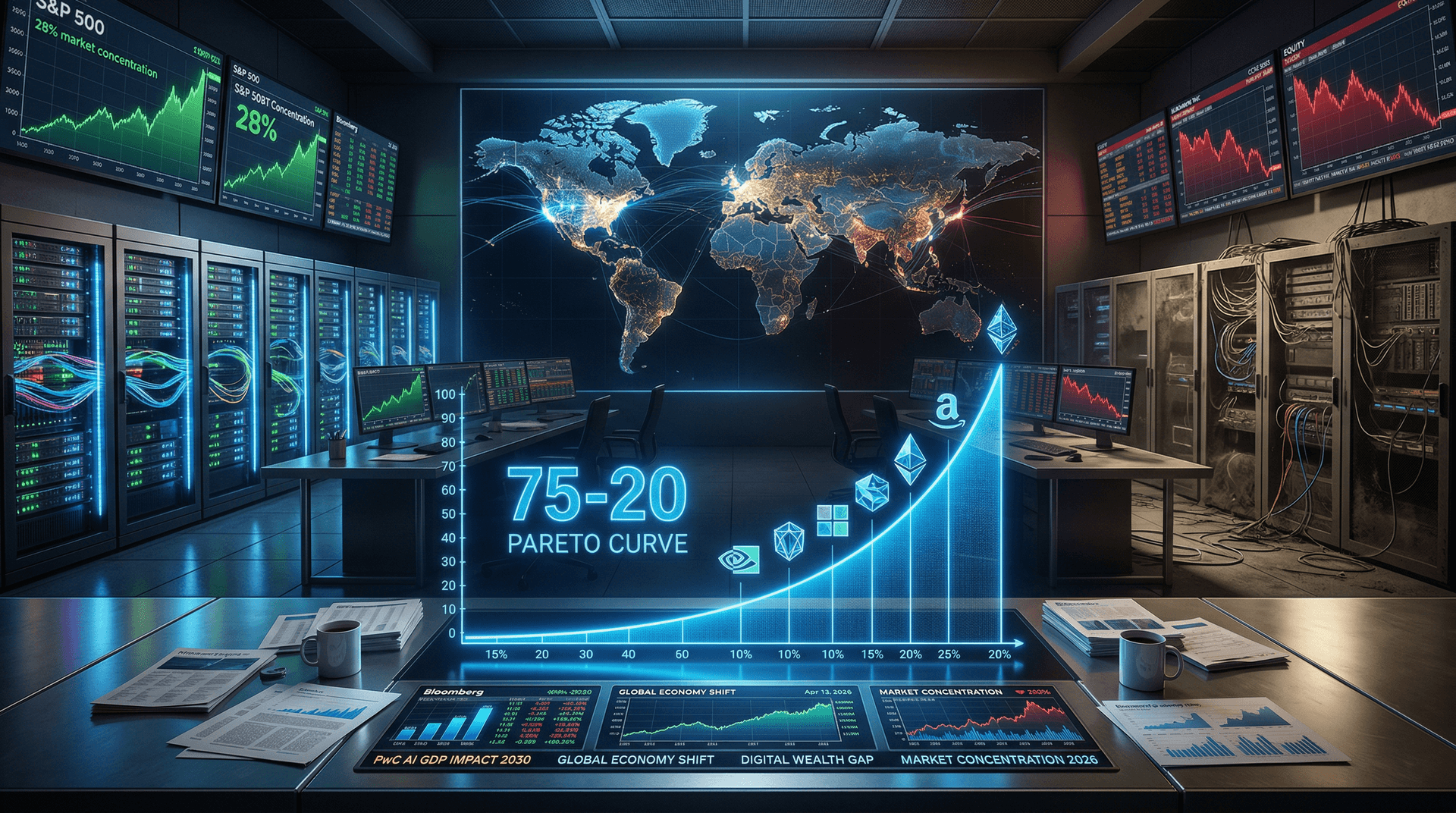
- PwC calculates 75% of AI economic gains flow to top 20% of global companies.
- Leaders post 45% higher productivity than laggards, PwC data confirms.
- S&P 500 concentration reaches 28%, heightening AI-driven market risks.
Key Takeaways
- PwC calculates 75% of AI economic gains flow to top 20% of global companies.
- Leaders post 45% higher productivity than laggards, PwC data confirms.
- S&P 500 concentration reaches 28%, heightening AI-driven market risks.
PwC's April 13, 2026, report details AI economic disparity. Top 20% of firms claim 75% of gains. Leaders scale infrastructure. Laggards battle integration costs.
PwC Details 75-20 AI Value Split
PwC studied 1,500 firms in finance and manufacturing. AI boosts global GDP by USD 15.7 trillion by 2030, per PwC's AI predictions report.
Top 20% firms seize 75% of value. They dedicate 12% of IT budgets to AI, PwC finds. Bottom 80% grab just 25% from patchy adoption.
Leaders secure 45% higher productivity gains versus laggards. "The AI value curve steepens," states Jonathan Atkinson, PwC US Artificial Intelligence Leader. Compute shortages widen the gap.
Nvidia and Microsoft command USD 3.2 trillion combined market caps as of April 2026, FactSet reports. They lead AI chips and cloud services.
Leaders Prioritize Generative AI
Top firms roll out generative AI and automation. PwC records 22% EBITDA margins for them, double the 8% firm average.
Amazon Web Services holds 31% cloud AI share, per Synergy Research Group Q1 2026. Clients slash inference costs 35%.
Google DeepMind integrates AI into search and ads. AI revenue jumps 28% year-over-year. PwC highlights proprietary datasets as key.
"Hyperscalers capture 60% of enterprise AI spend," says Beth Kindig, I/O Fund Lead Tech Analyst. Smaller players rely on their APIs.
S&P 500 Concentration Surges
S&P 500 Herfindahl-Hirschman Index climbs to 1,850, S&P Global data shows. Magnificent Seven stocks weigh 28%.
AI fuels the trend. Tech forward P/E ratios hit 35x, against 19x market-wide, FactSet notes.
Federal Reserve Chair Jerome Powell warned of antitrust risks in March 2026 congressional testimony. AI echoes 1990s tech bubble patterns.
"Concentration boosts downside volatility," cautions Lyn Alden, Lyn Alden Investment Strategy Macro Strategist. A 10% tech plunge drags S&P 500 down 4%.
AI Skew Creates Macro Risks
Investors face beta traps. AI ETFs like ARKK trade at 2.1x NAV premiums. Passive flows concentrate holdings.
China AI models trail US by 40% efficiency, PwC states. US tariffs expand supply chain edges, cementing US leads.
European Central Bank raises AI GDP boost to 1.2% annually in April 2026 statement. It warns of inequality effects on trade.
Russell 1000 Value Index drops 5% YTD, versus 12% growth surge, S&P Dow Jones Indices reports. Dispersion widens to 25 points.
Supply Chains Tilt Toward Leaders
AI demand lifts TSMC utilization to 95%. Lead times extend 26 weeks, Bloomberg reports April 13, 2026.
Leaders secure USD 50 billion forward contracts. Laggards pay 20% spot premiums in shortages.
US export controls block China AI access. PwC analysis routes gains to US vendors.
PwC projects USD 4.4 trillion yearly from AI agents by 2028. Top 20% take 80% through scale and ecosystems.
Investors Hedge AI Economic Disparity
Macro funds hedge AI economic disparity risks. BlackRock adds 15% to volatility positions, eyeing VIX above 25.
Nvidia reports earnings April 28, 2026. Consensus eyes USD 32 billion revenue, up 85% YoY, Bloomberg estimates.
DOJ antitrust probes target cloud giants. Outcomes spur H2 shifts to value stocks.
VIX at 20 signals bull steepener or risk unwind. Fed dot plot ties rate cuts to AI productivity metrics.